From Clinic Room to Claim Form—Mastering Documentation & Submission Basics
Learn how to write SOAP notes that map to billing codes and submit clean claims that get paid. A practical guide for wellness practice billing teams.
As a physical therapy or chiropractic student, your clinical skills are only part of the story. Translating hands-on care into accurate, compliant claims is essential for timely reimbursement—and for preparing you to step confidently into any practice setting. In this post, you'll learn:
- Why thorough documentation is the foundation of every claim
- How to write SOAP notes that map precisely to CPT® and ICD-10-CM codes
- How to generate and submit both electronic and paper claims
- Best practices for tracking claim status and managing denials
- Actionable tips to build strong habits before graduation
Why Good Documentation Equals Smooth Claims
"If it isn't documented, it wasn't performed." —Medicare Program Integrity Manual
Whether you submit claims electronically or via paper, every payer relies on your documentation to verify that the services billed were actually provided. Clear, complete notes help you:
- Prevent Denials: Payers routinely deny claims for missing details.
- Reduce Appeals: Every denied claim triggers a time-consuming appeal, delaying revenue by weeks.
- Protect Compliance: Consistent, audit-ready documentation minimizes risk of compliance reviews.
SOAP Note Framework: Your Blueprint for Coding
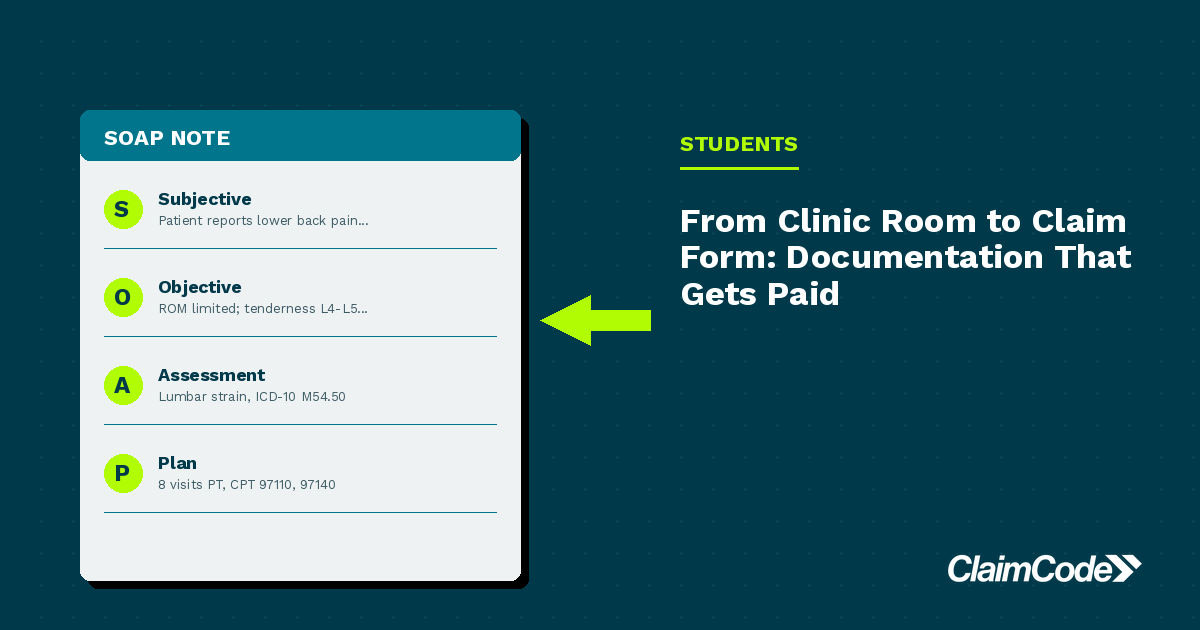
The SOAP note—Subjective, Objective, Assessment, Plan—is more than academic structure; it's the source document for every claim line.
Subjective (S)
- Content: Patient's own words about symptoms and goals.
- Billing relevance: Justifies why you selected specific services.
Objective (O)
- Content: Measurable findings—range of motion (ROM), strength, palpation.
- Billing relevance: Supports the medical necessity of each coded service.
Assessment (A)
- Content: Precise diagnosis (ICD-10-CM) and summary of exam findings.
- Billing relevance: Diagnosis codes underpin the medical necessity for each CPT® code.
Plan (P)
- Content: Services delivered (CPT® codes), units, frequency, and plan.
- Billing relevance: Translates directly into claim line items.
Generating and Submitting Claims
Depending on your future clinic's workflow, you may submit claims electronically or as a paper form.
Electronic Claims (ANSI X12 837P)
- Faster processing and acknowledgment
- Automated error edits prior to submission
- Direct receipt of Remittance Advice (835 ERA)
Paper Claims (CMS-1500)
- No clearinghouse fees for small volumes
- Straightforward for clinics with low claim volume
- Familiar format for staff trained on paper claims
Building Strong Billing Habits Before Graduation
- Use Customized Note Templates: Tailor SOAP templates for frequent scenarios.
- Practice with Sample Claims: Many EHR vendors offer demo environments.
- Shadow a Billing Specialist: Spending a morning with your clinic's biller provides real-world insight.
- Leverage Peer Learning: Share common scenarios with classmates.
By mastering the linkage between your clinical notes and every claim format, you'll graduate not only as a skilled hands-on practitioner but also as a confident navigator of the billing process.
Related Reading
Coding 101 for Wellness Students: CPT, ICD-10, and Modifiers Demystified
Master CPT codes, ICD-10-CM, and billing modifiers for chiropractic and physical therapy. A practical primer for wellness students and new billing staff.
Denied Outpatient Claims Rose 14% in 2025. Here's What That Costs the Average PT or Chiro Practice.
Denied outpatient claim amounts rose 14% in 2025. Here's what the math means for PT and chiro practices — and how to stop the revenue from walking out the door.

Dr. Andrew O'DonnellPhD, LSSGB
CEO and founder of ClaimCode. Expert in insurance analytics, digital transformation, and business operations. Passionate about helping private wellness practices manage their revenue cycle with meaningful insights.
Ready to stop losing revenue to denied claims?
ClaimCode gives your billing team real-time claim visibility and AI-powered remediation guidance — at flat-fee pricing.
Get Early Access